
Whether you’re planning a Mediterranean cruise, an Atlantic crossing, or a round-the-world trip, choosing the right sails is a crucial decision for your catamaran sailing project. Performance, durability, maneuverability, steering comfort… every factor matters. Here’s a guide from the Neo Marine team to help you make the right choice.
Why are catamaran sails so specific?
A catamaran’s width and natural stability impose very specific constraints on the sails:
Larger sail areas: the catamaran’s stability allows for more sail area.
Increased sensitivity to apparent wind: catamarans often sail at a speed close to the true wind speed, which changes how the sails work.
A need for reduced maneuverability: cruising crews are often small, sometimes just a couple. The sails must be easy to handle, even in bad weather.
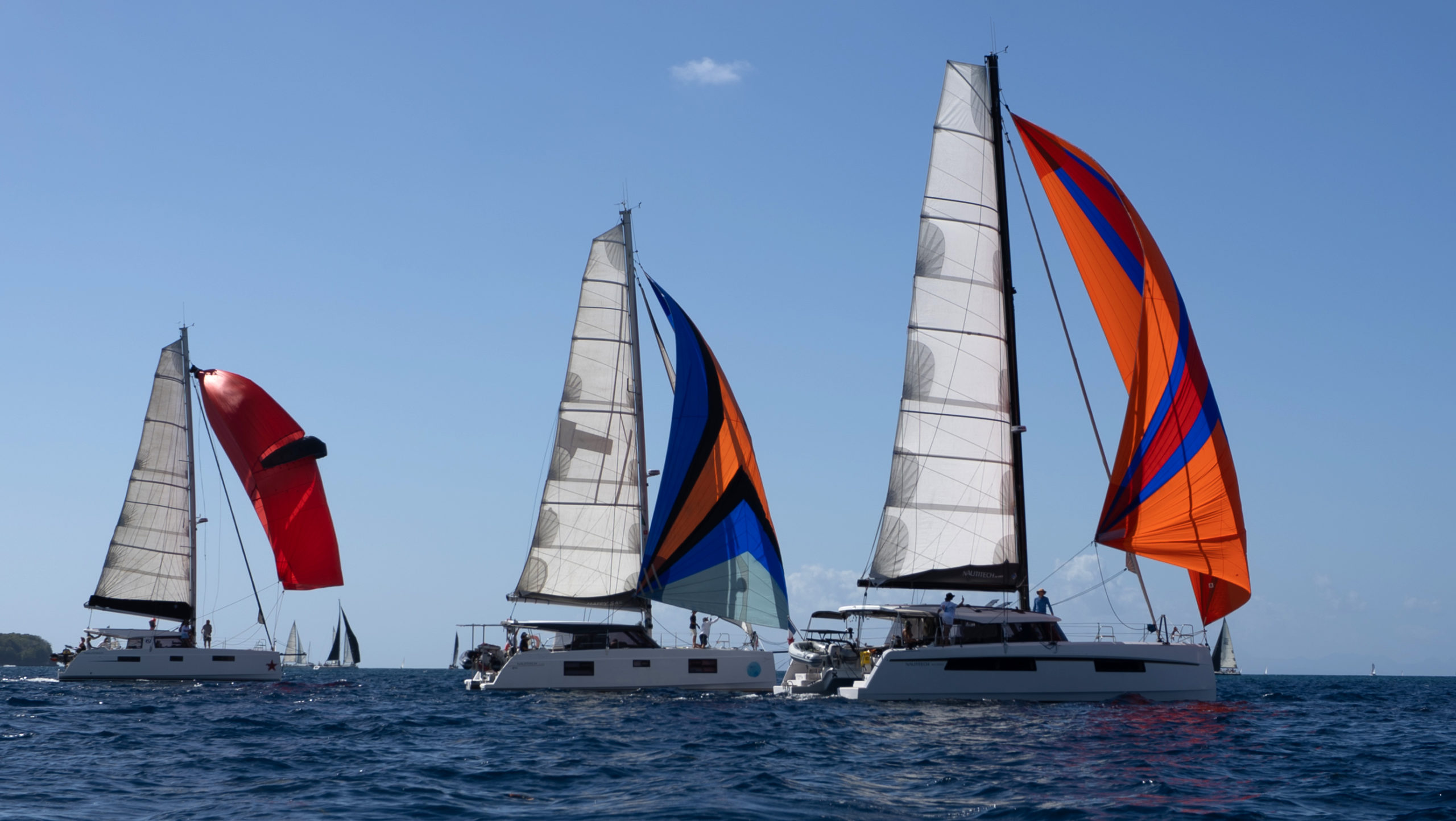
The mainsail: the main engine
It is the centerpiece. On a catamaran, it is usually set on a central mast, often without backstays, which allows for a great deal of flexibility in trimming. Several options are available:
The full-batten mainsail remains the most common solution. Sturdy, it offers a good aerodynamic profile and stows easily in a lazy bag.
The in-mast furling mainsail is ideal for small crews: a single winch is all that’s needed to furl or unfurl the sail. On the other hand, the profile is less efficient and maintenance is more complex.
The boom-furling mainsail combines the convenience of automatic stowage with a more efficient profile than the mast-furling system. It is becoming increasingly popular on cruising catamarans and allows for the placement of horizontal battens.
The genoa and the solent: for sailing close-hauled
The classic furling genoa is found on most catamarans. It is well-suited for coastal sailing and downwind conditions. For offshore passages, a solent or staysail is often preferred, as they are easier to handle and more efficient in strong winds.
On a voyage, you rarely sail close-hauled. The vast majority of the miles are covered on beam reach or downwind. This is where downwind sails make all the difference:
The asymmetric spinnaker: lightweight, powerful, but demanding to handle.
The gennaker or Code D: the ideal balance between performance and ease of use, it can be used from broad reach to beam reach.
Self-stabilizing sails: a game-changing innovation for long-distance sailing.
Materials: Dacron, laminate, or technical fibers?
Dacron (woven polyester) remains the standard for traditional sails. Affordable and easy to repair, it offers the best value for money. It is the most traditional material and is of good quality.
HydraNet ages well and withstands years of intensive use. It is the sensible choice for offshore sailing where reliability is non-negotiable. Highly repairable.
Laminates (Mylar, Spectra, Dyneema…) offer better profile retention and superior performance upwind. However, they are more sensitive to UV rays and repeated folding, and require more care. They are better suited for sailors seeking performance.
Membranes (DFI, DFI Fit) are reserved for competition and demanding projects.
At Neo Marine, we assist each customer in choosing the material best suited to their program, budget, and intended frequency of sailing.
Delta Voiles: French Excellence in Cruising
Delta Voiles is one of France’s leading sailmakers. All sails are designed by the design office in Montpellier, with a constant focus on quality and artisanal craftsmanship.
The Delta Voiles cruising range
For cruising catamarans, Delta Voiles offers a complete range of cruising sails: mainsails, headsails, and downwind sails. Materials are selected for their durability under real sailing conditions, including in tropical regions where UV radiation is intense and trade winds are strong. Two Delta downwind sails particularly catch our attention:
The Code D is a very interesting sail that sets and furls in just a few minutes. It is used from 60 to 140° of apparent wind, covering almost the entire range of use for the asymmetric spinnaker and gennaker. When used on a spinnaker pole, it can be used between 165 and 180°.
And the Code 0 is a truly versatile lightweight genoa for close-hauled conditions (5–15 true knots) up to 20 knots. Ideal for making the most of every breeze on coastal cruises or Atlantic crossings.
Neo Marine is a Delta Voiles distributor in La Rochelle and Martinique.
Oxley Sails: Innovation That Transforms Downwind Sailing
Oxley Sails represents a new approach to downwind sailing. Designed in Germany, Oxley sails feature a patented self-stabilizing wing design that is unmatched on the market.
Unlike a conventional spinnaker or gennaker, Oxley sails are equipped with a wing that generates lift in the upper part of the sail. This mechanism produces a self-balancing effect: the sail stabilizes itself, reduces pressure on the rudder, and minimizes autopilot corrections. This means less fatigue at the helm, energy savings on the autopilot batteries, a more relaxed sailing experience on long crossings, and excellent maneuverability even with a small crew.
The BORA sail: the queen of long distances
The BORA sail is specially designed for offshore sailors. Its double-layer wing traps air that acts as a flexible batten, stabilizing the sail from leech to luff. It excels in trade winds and steady winds on long crossings. If you’re planning an Atlantic crossing or a round-the-world voyage, the BORA is undoubtedly the most suitable downwind sail.
The LEVANTE sail: for thrill-seekers
The LEVANTE sail features a unique, extremely lightweight membrane construction. It fills out even in the lightest breezes and responds instantly to changes in wind direction. It is the ideal sail for sailors looking to make the most of every gust of wind, whether cruising along the coast or on an offshore voyage.
Voici les questions à se poser avant de passer commande :
Quel est votre programme de navigation ? Croisière côtière, transat, tour du monde… les exigences ne sont pas les mêmes. Une voile pour les alizés sera différente d’une voile pour la Méditerranée.
Quelle est la taille de votre équipage ? Un équipage de deux personnes a besoin de voiles faciles à manœuvrer seul, avec des systèmes d’enroulement ou des voiles auto-stabilisantes. Un équipage de quatre ou cinq personnes peut se permettre des voiles plus techniques.
Quel est votre budget global ? Une voilure complète représente un investissement conséquent. Il est possible d’optimiser en choisissant du dacron pour les voiles les plus sollicitées comme la grand-voile, et des matériaux plus techniques pour les voiles de portant, moins exposées aux plis répétés.
Votre catamaran est-il récent ou ancien ? Un catamaran d’occasion peut avoir besoin d’une voilure entièrement refaite. Un catamaran neuf peut nécessiter une voilure sur mesure adaptée à ses dimensions exactes.
Here are some questions to ask yourself before placing an order:
What are your sailing plans? Coastal cruising, transatlantic crossings, round-the-world voyages… the requirements are not the same. A sail for the trade winds will be different from a sail for the Mediterranean.
How many crew members do you have? A two-person crew needs sails that are easy to handle alone, with furling systems or self-stabilizing sails. A crew of four or five can opt for more technical sails.
What is your overall budget? A complete set of sails represents a significant investment. You can optimize costs by choosing Dacron for the most heavily used sails, such as the mainsail, and more technical materials for downwind sails, which are less exposed to repeated folding.
Is your catamaran new or older? A used catamaran may need a complete set of new sails. A new catamaran may require custom sails tailored to its exact dimensions.
OUR SUPPORT AT NEO MARINE
At Neo Marine, we offer personalized advice to help you choose the ideal sails for your boat, your itinerary, and your budget. We partner with Delta Voiles and Oxlet Sails to provide custom-made sails. We support you throughout your project from start to finish.
Planning a sailing trip? Contact our sailmaking team for a personalized quote. We’re located in La Rochelle and Martinique, two must-visit stops on any serious sailor’s itinerary.
Discover what our customers have to say about making their dreams a reality: check out our videos on YouTube to hear their sailing stories or take a tour of a boat.
Ready to set sail? Contact us today to start your adventure and stay in touch.